Let me ask you something — when was the last time you Googled your own brand? Chances are, what popped up wasn’t just your website or your latest press release. Increasingly, it’s AI-powered summaries, automated reviews, and machine-generated overviews that shape those first impressions. We’ve officially entered the era where Large Language Models (LLMs) — think ChatGPT, Claude, Google’s AI Overviews, and Perplexity — are reading, summarizing, and judging your brand in real time. And here’s the catch: they’re doing it whether you’re paying attention or not.
These AI systems don’t operate like traditional search engines. They don’t just serve up a list of links — they synthesize opinions, extract reputational signals, and package your brand into a neat little narrative that users read before they ever visit your site. Whether that story flatters or damages your reputation depends on how well your digital presence is managed across platforms.
And here’s where things get tricky: LLMs aren’t reading your carefully crafted marketing copy in isolation. They’re pulling insights from reviews on Google, discussions on Reddit, posts on Quora, threads buried deep in industry forums — even outdated blog posts you’ve long forgotten about. It’s the digital equivalent of word-of-mouth at hyperscale, only now it’s automated, always-on, and largely outside your direct control.
In this article, we’re going to unpack how AI models interpret your brand, why reputation management now extends far beyond SEO or public relations, and — most importantly — what you can do to influence the narrative AI is telling the world about your business.
The current behavior of LLMs and AI overviews regarding brand reputation
If you’ve interacted with ChatGPT, Perplexity, or even noticed those new AI Overviews popping up in Google Search, you’ve already seen how fast the information landscape is changing. But behind the scenes, these tools are doing more than just answering questions — they’re shaping brand reputations in ways most companies aren’t fully prepared for.
Let’s break down how this actually works.
How LLMs read brand reviews and content
At their core, Large Language Models are trained to read, summarize, and predict patterns in text. But they’re only as good as the data they pull from — and when it comes to your brand, that data is scattered across dozens of public platforms. We’re talking about:
- Google Reviews
- Trustpilot
- Clutch and other B2B directories
- Reddit discussions
- Quora threads
- Social media chatter
- News articles and blogs
These sources feed into AI’s understanding of your brand’s reputation, sometimes without your direct involvement. For example, you might have stellar messaging on your website — but if your last few Google Reviews are negative, or there’s a Reddit thread questioning your product quality, LLMs will likely factor that in.
The role of AI Overviews in Google Search
This becomes even more visible with Google’s AI Overviews. Imagine a potential client searching your brand name. Instead of sifting through pages of results, they see a quick, AI-generated summary at the top — pulling in sentiment, reviews, and key points from across the web. Those few sentences can become their entire first impression.
For better or worse, AI isn’t concerned with the nuances of your brand story. It cares about patterns, signals, and consensus — meaning outdated reviews, one viral negative post, or even inaccurate forum discussions can follow you around in AI responses.
The impact of negative sentiment in AI outputs
Here’s where things get uncomfortable — but it’s critical to understand.
LLMs and AI search tools aren’t emotionally invested in your brand. They read patterns of sentiment, often giving disproportionate weight to risk signals, negative reviews, or controversy. That means a handful of poor reviews or one unresolved complaint can echo through AI-generated summaries long after the original issue is resolved.
Let me give you a few scenarios we’ve been seeing more and more:
- A SaaS company receives several critical reviews on Clutch following a buggy product release. Months later, despite fixing the issues, ChatGPT summaries still highlight “customer dissatisfaction” when asked about the company’s reliability.
- A mid-size B2B firm has a Reddit thread questioning their pricing transparency. AI Overviews pick this up, and now, prospective clients searching the brand see “concerns over unclear pricing” embedded right into Google results.
- Negative sentiment appears in AI-generated competitor comparisons. You ask Perplexity to compare two vendors, and it paraphrases your outdated negative reviews while showcasing your competitor’s strengths.
Worse yet, this information can become “sticky.” Meaning, once an AI model learns and repeats negative information, it tends to persist — even when newer, more positive content exists. Essentially, AI can lock your reputation into a time capsule of past mistakes.
It’s not personal — it’s just the nature of predictive models. But if you’re not actively managing your reputation across these digital spaces, the AI systems shaping public perception might be working against you without you even realizing it.
Real-world AI reputation case studies
If you’ve been wondering whether LLMs and AI Overviews genuinely influence buyer decisions — the answer is right in front of us. Here are some live, relatable examples of how AI summarizes brands, shapes reputations, and sometimes locks companies into narratives they didn’t script themselves.
Case Study 1: Product reviews summarized by AI (Climbing Backpacks Example)
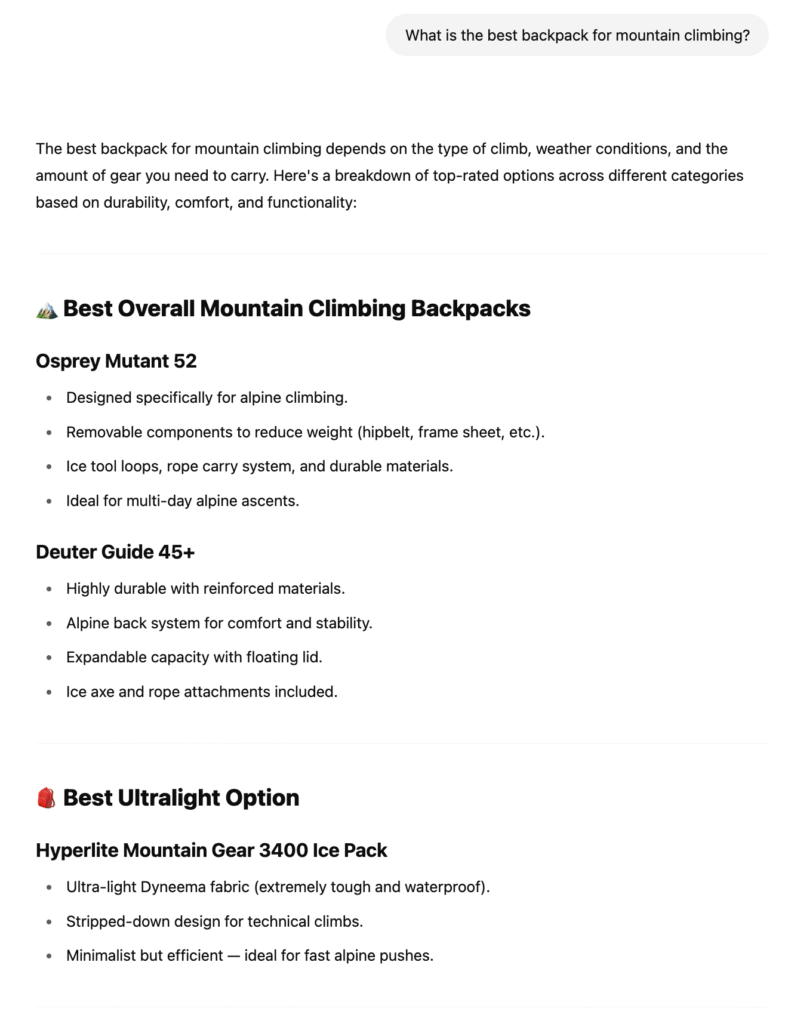
Take the backpack industry, for instance. When users ask ChatGPT for “the best backpack for mountain climbing,” the AI doesn’t just list products — it synthesizes sentiment from review sites like GearLab, OutdoorGearLab, and Reddit threads.
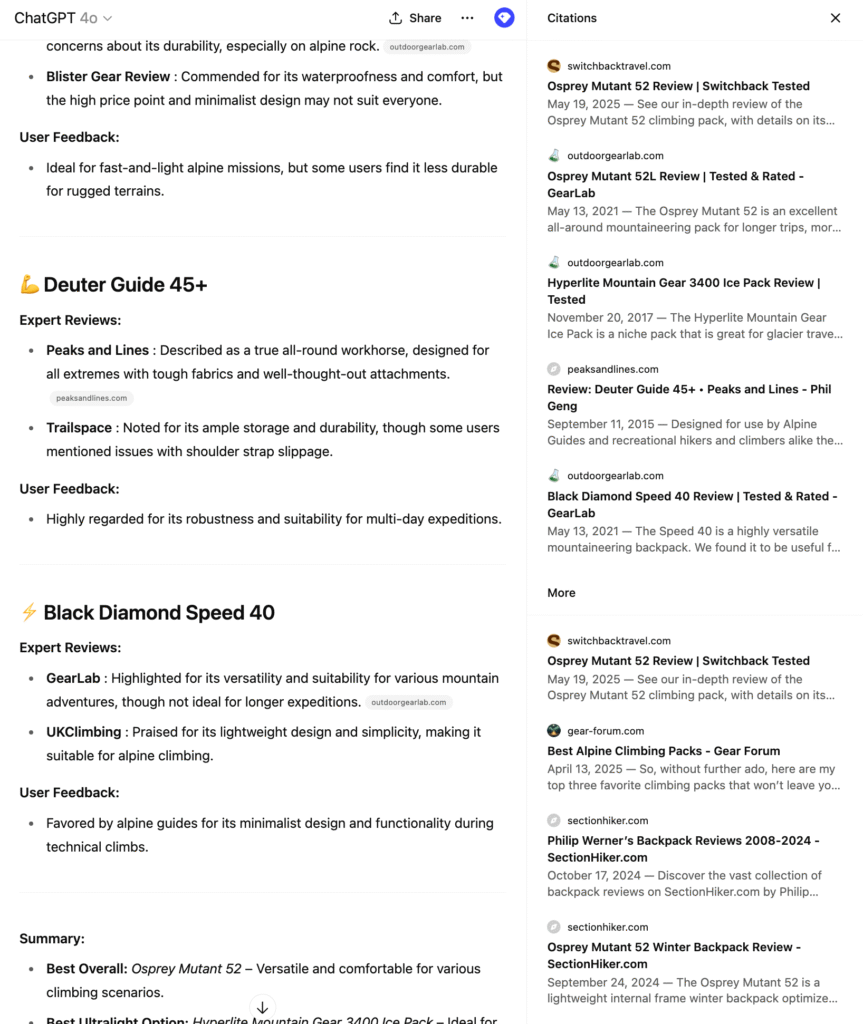
In one AI-generated response, the Osprey Mutant 52 is crowned “Best Overall,” while the Hyperlite Mountain Gear 3400 Ice Pack earns “Best Ultralight Option,” but with durability concerns called out from expert reviews and user feedback.
What’s happening here? AI models are scanning published reviews, expert breakdowns, and scattered online opinions — turning them into sticky, reputation-defining summaries. The good, the bad, and even minor complaints resurface, shaping the buying journey before a consumer ever reaches the official website.
Why it matters: If this were your product, outdated reviews or a few vocal critics could define your reputation in AI tools, even after improvements are made.
Case Study 2: Google AI Overviews reshaping local recommendations (Chicago Pizza Example)
Search “best pizza place in Chicago” today, and Google’s AI Overview doesn’t just offer a map or list — it curates an AI-written narrative. In one live example, Pequod’s Pizza is spotlighted for its “caramelized crust” and rave Yelp reviews, while Lou Malnati’s and Giordano’s are also praised.
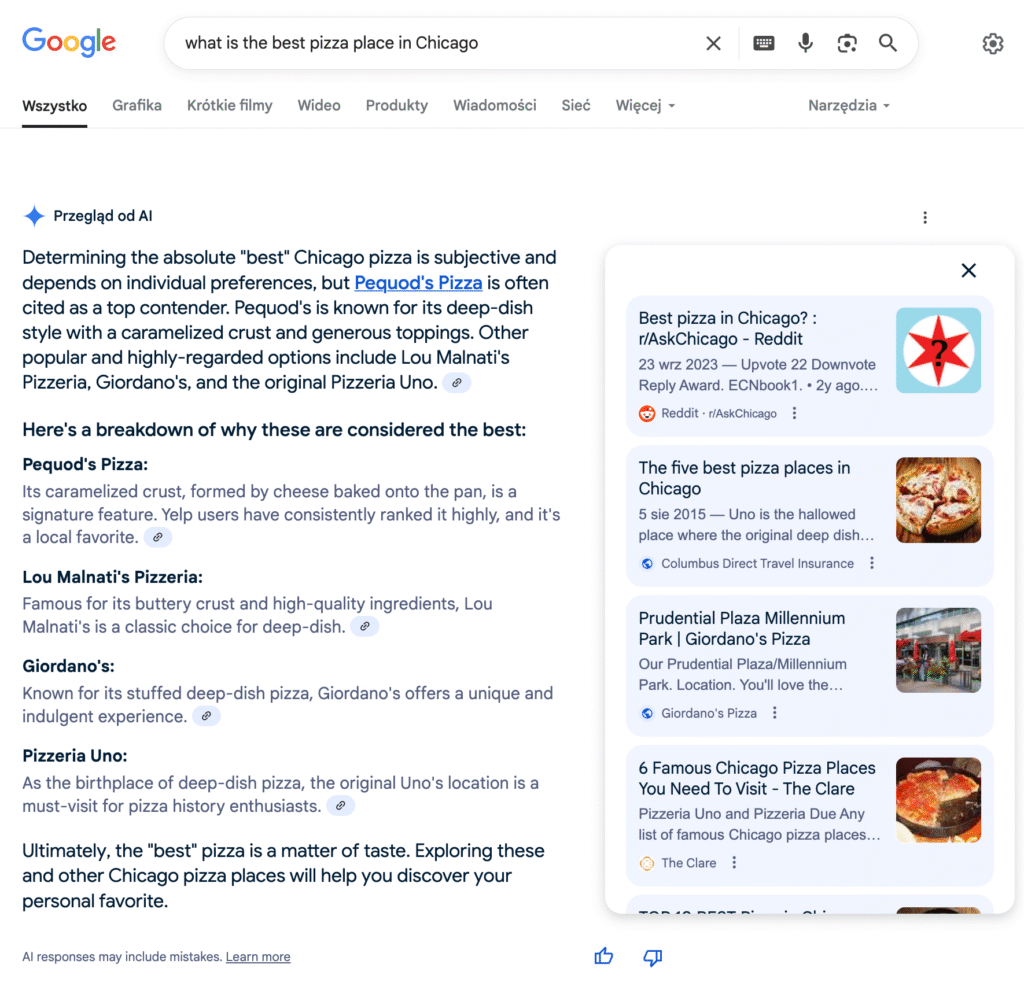
Notice what’s happening: AI is simplifying complex consumer reviews, social chatter, and publication rankings into a neat story. Businesses with strong, positive digital footprints get amplified. But if your brand falls behind on reviews or faces controversy, that can easily show up in these AI snippets — even at the hyper-local level.
Why it matters: AI Overviews increasingly dictate foot traffic, bookings, and purchasing decisions, all based on how your reputation appears in online data — not just your marketing.
Case Study 3: AI-generated software company rankings (Chicago Tech Scene)
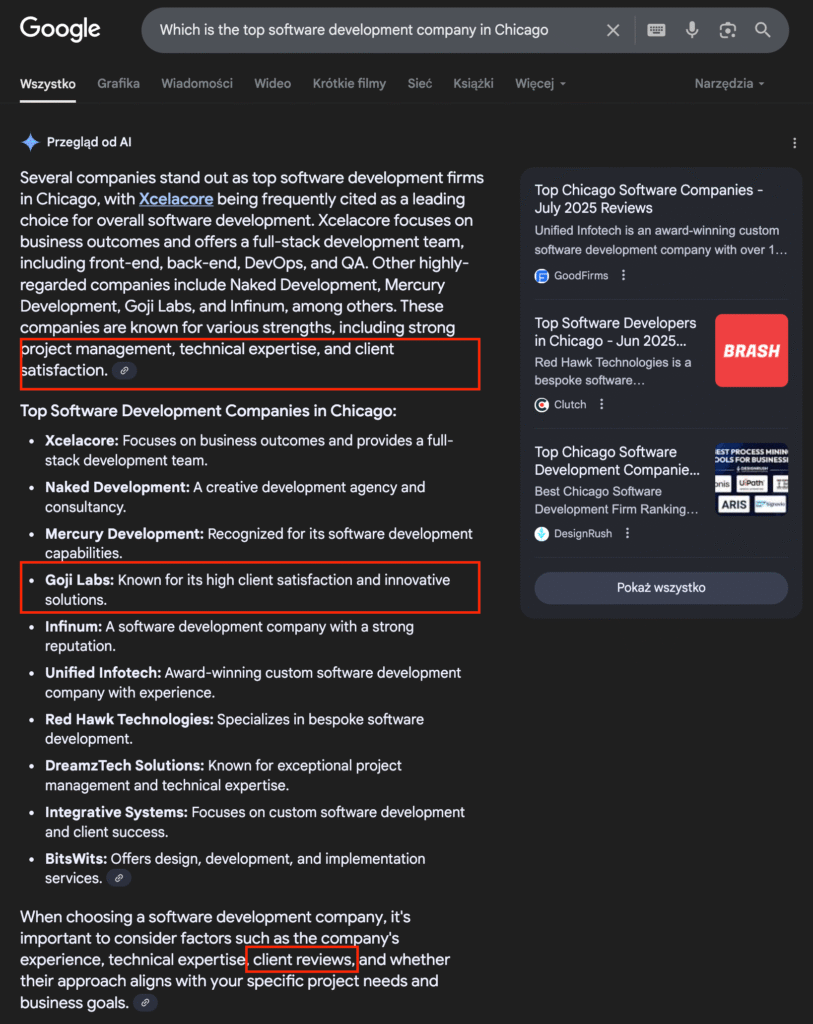
Now, shift to the B2B world. When potential clients search “top software development company in Chicago,” Google’s AI Overview doesn’t merely rank websites — it summarizes firms based on perceived strengths, like “technical expertise” and “client satisfaction.”
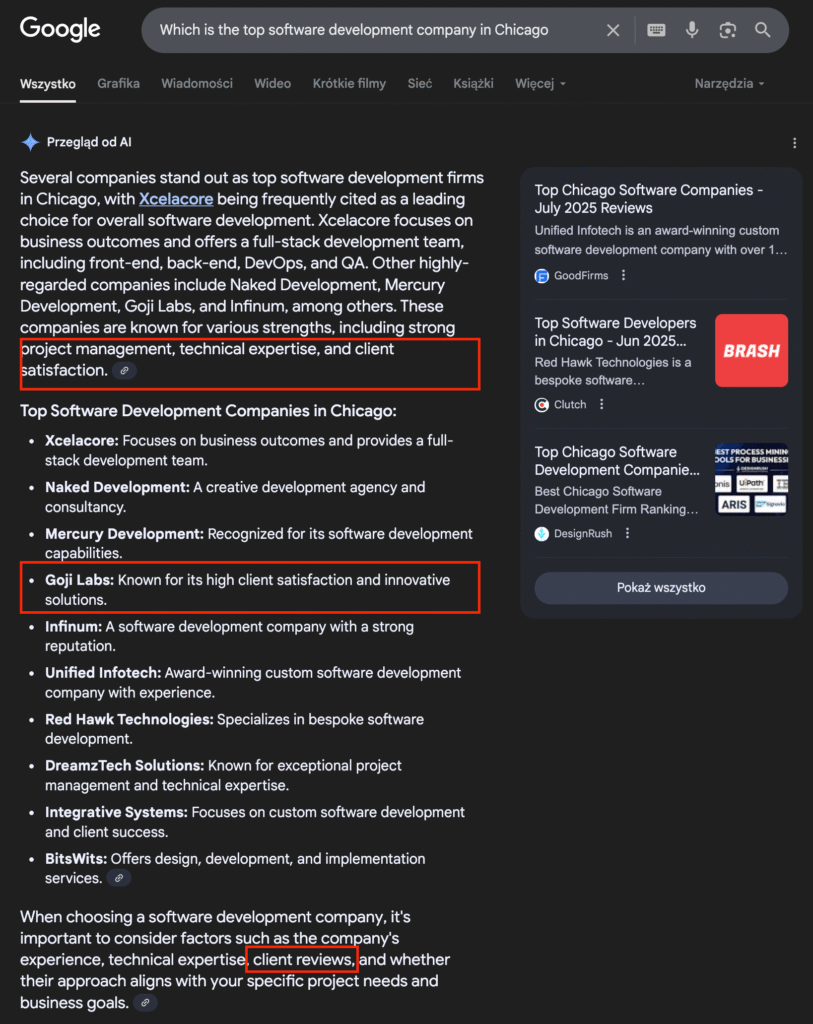
Look closer, and you’ll see companies like Goji Labs highlighted for “innovative solutions” and positive reviews. But where does this come from? The AI is pulling sentiment from Clutch, Google Reviews, DesignRush, and other third-party sources — not from your paid ads or press releases.
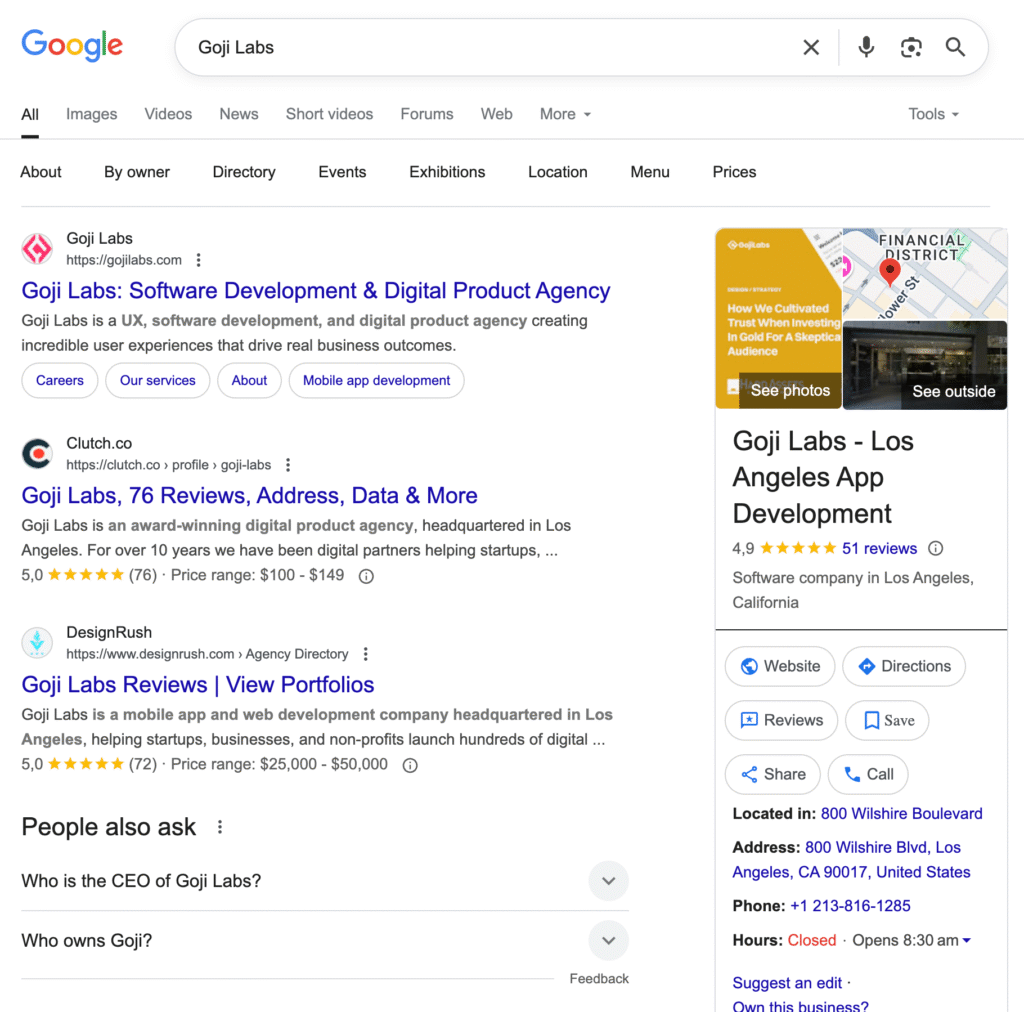
In fact, when searching Goji Labs directly, their 4.9-star Google rating and Clutch reviews feature prominently, reinforcing the AI’s summary narrative.
Why it matters: B2B buyers increasingly rely on AI-curated brand assessments. If your reviews, third-party profiles, or social mentions fall short, LLMs could quietly filter your company out of consideration.
Why AI amplifies reputation signals
Here’s the uncomfortable truth most companies are just waking up to: AI doesn’t just reflect your reputation — it amplifies it. Good, bad, outdated, or even inaccurate, once a signal exists online, LLMs are incredibly good at picking it up, repeating it, and embedding it into automated summaries seen by your prospects.
We call this the AI amplification effect, and it’s reshaping how brands are discovered, compared, and trusted in every industry — from e-commerce to B2B SaaS to local services.
Why AI amplifies reputation signals
Think of it this way: AI models like ChatGPT, Claude, and Google’s AI Overviews operate on probability. They predict what information is most relevant or accurate based on patterns in their training data. If your brand is consistently mentioned with positive reviews, helpful content, and strong thought leadership, AI will likely summarize your brand favorably.
But if even a small percentage of online sentiment is negative — outdated product complaints, unresolved customer issues, viral criticism — AI latches onto those signals too.
Here’s what that looks like in practice:
- A few negative Google Reviews from last year resurface in AI Overviews today
- Reddit discussions questioning your service linger in ChatGPT summaries
- Old blog articles with unfavorable comparisons still appear in Perplexity answers
It’s like your brand reputation gets stuck on loop — AI repeats the same narratives, making them feel like consensus, even when they’re outdated or no longer relevant.
The “stickiness” of negative AI outputs
One of the most frustrating aspects of AI-driven reputation is how sticky negative impressions can be. LLMs, by design, lean toward risk mitigation. That means:
- They may overemphasize complaints, quality concerns, or service gaps
- They frequently surface “potential drawbacks” even when balanced by positives
- They retain outdated reputational signals unless overwhelmed by fresh, authoritative content
This is especially true in high-consideration industries like software development, healthcare, or financial services, where buyers are searching for trust signals — and AI models instinctively surface both strengths and red flags.
Bottom line: If you’re not actively managing how your brand appears across review platforms, forums, and third-party sites, AI may be reinforcing outdated or damaging perceptions — often without you realizing it.
How AI user behavior reinforces brand perception
Here’s the part most brands underestimate: AI doesn’t work in isolation. It evolves based on user behavior, feedback loops, and the content ecosystem surrounding your business. Put simply, how people search, click, and engage with your brand influences how LLMs interpret and summarize your reputation moving forward.
Let me explain.
When users consistently see negative AI-generated summaries — for example, outdated complaints in Google’s AI Overviews — they’re more likely to:
- Click away from your website
- Engage with competitor options
- Discuss your shortcomings on forums like Reddit or Quora
And the kicker? Those very actions provide new training signals to the AI, reinforcing the negative perception. It becomes a self-perpetuating cycle — poor AI reputation → reduced trust → fewer clicks → more negative signals → persistent AI bias.
In contrast, brands that proactively build positive signals across trusted platforms create a different loop. Verified reviews, expert endorsements, and helpful, AI-friendly content improve the AI’s understanding of your business. Over time, this shapes more favorable AI-generated responses, which increases clicks, conversions, and brand authority.
This is exactly why growth-focused businesses are evolving beyond traditional SEO to embrace AI-specific visibility strategies. You can dive deeper into that approach in our article on AI SEO Visibility Strategy.
The takeaway? Your AI reputation isn’t static — it’s dynamic, reactive, and influenced by both your digital footprint and how real people engage with your brand across the web.
How to improve and influence your AI reputation
If AI is reading, summarizing, and broadcasting your brand’s reputation — often without your direct input — the logical next step is to actively influence those signals. Thankfully, businesses can take control by shaping the digital ecosystem that feeds LLMs.
Let’s break this down into clear, proven strategies.
Boosting positive brand signals for AI visibility
The fastest way to influence AI outputs? Flood the right data sources with positive, verifiable brand signals. Remember, LLMs like ChatGPT, Claude, and Google AI Overviews pull heavily from:
SaaS Business Reputation Sources
- G2
Influential software review platform where AI models often pull product rankings and customer sentiment. - Capterra
A major SaaS discovery site — reviews here directly influence AI summaries for software products. - TrustRadius
Trusted B2B software review platform, frequently cited in AI comparisons and summaries. - Product Hunt
Product launches and user reviews often inform AI-generated insights for new SaaS tools. - Reddit – SaaS & Startups | r/startups
Community discussions surface in AI training data, shaping product reputation. - LinkedIn Company Pages
LLMs pull company descriptions, updates, and employee advocacy from LinkedIn. - TechCrunch
Press mentions here boost AI reputation visibility, especially for funded startups. - Glassdoor
Employee reviews and company ratings impact AI-driven summaries around culture and leadership. - Crunchbase
Funding rounds, company profiles, and key metrics often appear in AI-generated overviews. - Quora SaaS Discussions
User questions and recommendations influence AI brand interpretations in software.
B2B (Non-SaaS Services, Consulting, Agencies) Reputation Sources
- Clutch.co
Essential directory for B2B services — LLMs frequently summarize reviews and rankings here. - Trustpilot B2B
Trusted source of reviews for B2B businesses, heavily referenced by AI. - GoodFirms
B2B marketplace and review platform used by AI to evaluate service providers. - DesignRush
Directory for creative agencies, design firms, and consultants that feeds AI search data. - LinkedIn Company Pages
Company profiles, leadership posts, and industry content that LLMs parse for reputation signals. - Reddit – B2B & Consulting
Client experiences and industry discussions that shape AI perceptions of B2B brands. - Google Reviews
Office locations with Google Reviews impact AI Overviews for B2B firms. - Forbes
Trusted media citations that AI often includes in reputational summaries. - Company Blogs & Case Studies
High-authority content informs how AI summarizes expertise and success stories. - Quora – B2B Solutions
B2B recommendations and reputation discussions AI tools may reference.
Local Business Reputation Sources
- Google Business Profile
The #1 source for AI Overviews of local businesses — reviews here are critical. - Yelp
Popular review platform, especially influential for food, retail, and service industries. - Facebook Business Reviews
Social proof from Facebook often feeds into AI’s understanding of your reputation. - TripAdvisor
Travel, hospitality, and local attractions reviews AI systems summarize frequently. - Better Business Bureau (BBB)
Trusted for business trust signals, heavily weighted by AI for US-based companies. - Local News Sites (Example)
Coverage of events, openings, or incidents in local news often appears in AI Overviews. - Reddit – City/Regional Subreddits (example: r/Chicago)
Local community discussions that influence AI-generated brand summaries. - Nextdoor
Hyper-local reputation conversations that AI increasingly factors into search. - Chamber of Commerce Listings
Verified business listings that help establish legitimacy with AI systems. - Quora – Local Recommendations
Questions and answers shaping AI perception of neighborhood services and businesses.
Here’s your playbook for strengthening those signals:
- Encourage verified reviews: Happy customers are your best asset. Prompt them to leave reviews on Google, Trustpilot, or Clutch — especially after successful product experiences, project completions, or support resolutions. LLMs trust these verified platforms.
- Drive authentic engagement on discussion forums: Don’t underestimate platforms like Reddit or Quora. Industry threads, product recommendations, or honest customer success stories often appear in AI training data — influencing how your brand is summarized.
- Respond transparently to negative feedback: AI systems factor in your responsiveness. Brands that address complaints, offer solutions, and demonstrate accountability online tend to be portrayed more favorably in AI outputs.
If you’re managing growth or marketing in B2B SaaS, this approach aligns closely with broader growth marketing manager tactics — combining review management, customer advocacy, and digital reputation into one scalable strategy.
Creating AI-friendly brand content
Next comes your owned content — the information you publish across your website, blogs, and third-party platforms that AI systems crawl, read, and summarize.
To ensure your brand content works for you, not against you:
- Prioritize high-authority, SEO-optimized articles: AI models lean on top-ranking content to form their summaries. Focus on publishing well-researched, expert-driven articles that establish credibility in your niche.
- Implement schema markup: Structured data (schema) helps search engines and AI systems better understand your site. Mark up reviews, product details, and company information to improve visibility in AI-generated snippets.
- Dominate public-facing brand spaces: Make sure your website, social profiles, and listings clearly convey your brand story, mission, and strengths. If you don’t control the narrative, AI will pull it from less favorable sources.
This isn’t theoretical — we’ve seen firsthand how investing in AI-friendly content improves not only search visibility but how LLMs paraphrase and present brands across platforms.
You can explore detailed strategies in our AI SEO Visibility Strategy guide, designed to future-proof your content for AI-driven search environments.
How to monitor and correct AI reputation
The uncomfortable reality is that most businesses don’t realize how AI presents their brand until it’s already affecting clicks, conversions, or sales conversations. By then, outdated reviews or negative sentiment may have quietly shaped buyer perception.
That’s why active monitoring of your AI reputation isn’t optional anymore — it’s essential.
Here’s how to stay ahead of what AI systems are saying about your brand:
Test LLM Responses Regularly
Search your brand or product name directly in ChatGPT, Perplexity, and Claude or use Answerthepublic. Ask questions like:
- “Is [Your Brand] a good option for [your product category]?”
- “What do people say about [Your Brand]?”
- “Compare [Your Brand] vs [competitor].”
Pay close attention to the language, sentiment, and sources the AI cites. If you spot outdated information or negative summaries, it’s a red flag your AI reputation needs attention.
Audit Google AI Overviews
Google’s AI-generated summaries are now front and center in search results. Run branded and unbranded keyword searches and note:
- Are positive reviews showing up?
- Is your messaging consistent?
- Are outdated or inaccurate statements persisting?
If misinformation appears, your next step is to correct the content.
Publish Corrective, AI-Friendly Content
LLMs rely on recent, high-authority sources. To counter negative signals:
- Publish fresh, SEO-optimized blogs, case studies, and news updates
- Address outdated complaints directly on your website
- Engage with forums and review platforms to shift sentiment
For detailed strategies, check our AI SEO Visibility Strategy guide.
Report Inaccuracies Where Possible
Some platforms, like Google Business Profile or Clutch, allow businesses to dispute incorrect information or outdated reviews. Use these channels — LLMs often scrape these trusted sources.
Remember, monitoring your AI reputation is not a one-time exercise — it’s ongoing, just like growth marketing management.
Crisis management in the AI-driven reputation landscape
Reputation crises aren’t new — but the AI era has made them faster, stickier, and more public than ever.
Let’s say your brand faces:
- A viral Reddit thread criticizing your product
- A wave of negative Trustpilot or Google reviews
- Negative press coverage picked up by AI Overviews
Without action, those signals become embedded in AI summaries across search engines, LLM chatbots, and content aggregators.
Here’s your AI-specific crisis management playbook:
Immediate Response Across Platforms
Acknowledge issues directly on review platforms, social channels, and your website. AI models favor brands seen as transparent and proactive.
Suppress Outdated or Negative Signals
Flood trusted sources (Google Reviews, Clutch, G2, authoritative blogs) with updated, positive content. The goal is to outnumber the negative with verifiable, fresh information.
Leverage Owned Media Channels
Publish official statements, FAQs, and corrective content optimized for AI summarization — using schema markup and structured data.
Monitor AI Outputs for Lingering Issues
Even after a crisis calms, LLMs may retain outdated negative summaries. Test ChatGPT, Google AI Overviews, and Perplexity regularly to confirm the narrative is evolving.
Crisis management isn’t just about public relations anymore — it’s about ensuring AI systems don’t lock your brand into a damaging feedback loop.
Long-term AI reputation management strategies
Think of AI reputation as a new competitive frontier — the companies that master it will dominate visibility, trust, and conversion rates over the next decade.
Here’s how to build a resilient, AI-friendly reputation for the long haul:
Treat AI Outputs Like Search Rankings
If you already invest in SEO or paid search, think similarly about AI reputation. Regular audits, optimization, and strategic content creation are key.
Align PR, SEO, and Reputation Management with AI Trends
Your PR wins, thought leadership, and SEO-optimized content should work together to feed positive signals into AI systems — reinforcing credibility across platforms.
Invest in AI Reputation Monitoring Tools
Emerging tools now track how your brand appears in AI Overviews, chatbots, and LLM-generated responses. Integrate these into your tech stack for early detection.
Champion Verified Reviews and Third-Party Endorsements
LLMs trust platforms like Trustpilot, Clutch, and G2 — actively cultivate your presence here.
Proactively Shape AI-Friendly Narratives
Own your story with high-quality, structured content optimized for AI summarization — especially for key product categories or competitive comparisons.
The reality is simple: AI isn’t just summarizing your brand — it’s shaping how prospects, investors, and partners perceive you. Long-term success depends on managing both human and AI-facing reputational signals.
Recommended tools for monitoring AI reputation and brand signals
If AI models like ChatGPT, Claude, Google AI Overviews, and Perplexity are summarizing your brand, you need visibility into what they see — and fast. The good news? Several tools can help track, measure, and correct your AI reputation across platforms.
Here’s a curated list, broken down by need:
AI Search & Overview Monitoring Tools
- Perplexity Pro
https://www.perplexity.ai/pro
Run branded queries and track how Perplexity summarizes your company over time. - ChatGPT with Web Access (Plus Plan)
https://chat.openai.com/
Regularly test your brand reputation using GPT-4o with browsing to catch outdated or negative summaries. - Google AI Overviews Monitoring (Manual)
https://www.google.com/
Search branded and unbranded keywords to track AI-generated search snippets that shape first impressions. - Glasp (AI Snapshot Tool)
https://glasp.co/
Use to capture and analyze AI-generated answers across different platforms for trend tracking.
Review & Sentiment Monitoring Platforms
- Google Business Profile Dashboard
https://www.google.com/business/
Manage and respond to reviews that heavily influence AI Overviews and local search results. - Trustpilot Business
https://business.trustpilot.com/
Monitor and manage your reviews — AI tools frequently scrape sentiment from this platform. - Clutch Profile Management
https://clutch.co/
Essential for B2B service businesses — keep your Clutch profile and reviews accurate and updated. - Reddit Keyword Alerts (via tools like BrandMentions)
https://brandmentions.com/
Track brand mentions across Reddit and other forums where AI models pick up real-world discussions.
Comprehensive Brand Monitoring & AI Reputation Tools
- Brand24
https://brand24.com/
Real-time monitoring for online mentions, reviews, and sentiment across web and social — includes AI-ready data feeds. - Mention.com
https://mention.com/
Track your brand across media, blogs, forums, and social spaces — identify emerging reputation risks early. - Reputation.com
https://www.reputation.com/
Full-suite reputation management platform, ideal for local businesses and multi-location brands impacted by AI Overviews. - Nozzle (SERP & AI Snippet Tracking)
https://nozzle.io/
Monitor your brand’s position in search and identify how AI snippets like Google’s AI Overviews affect visibility.
Bonus Tip: Pair these tools with a structured content strategy, outlined in our AI SEO Visibility Strategy, to actively influence the narrative AI systems create around your brand.
Final thoughts: Your reputation is no longer human-only
The era of AI shaping brand perception is here — and it’s moving faster than most businesses expect.
First impressions are increasingly automated. Negative reviews, viral criticism, or outdated content can lock into AI-generated summaries — hurting trust, traffic, and revenue.
But the flip side? With proactive review management, strategic content creation, and ongoing AI system monitoring, you can influence how LLMs present your business at scale.
Start now:
Audit your AI reputation across platforms
Strengthen positive signals on trusted review sites
Optimize your content for AI discoverability
If you need help building a reputation strategy designed for the AI era, reach out through my contact page. Let’s ensure your brand is seen — by humans and AI — in the best possible light.